

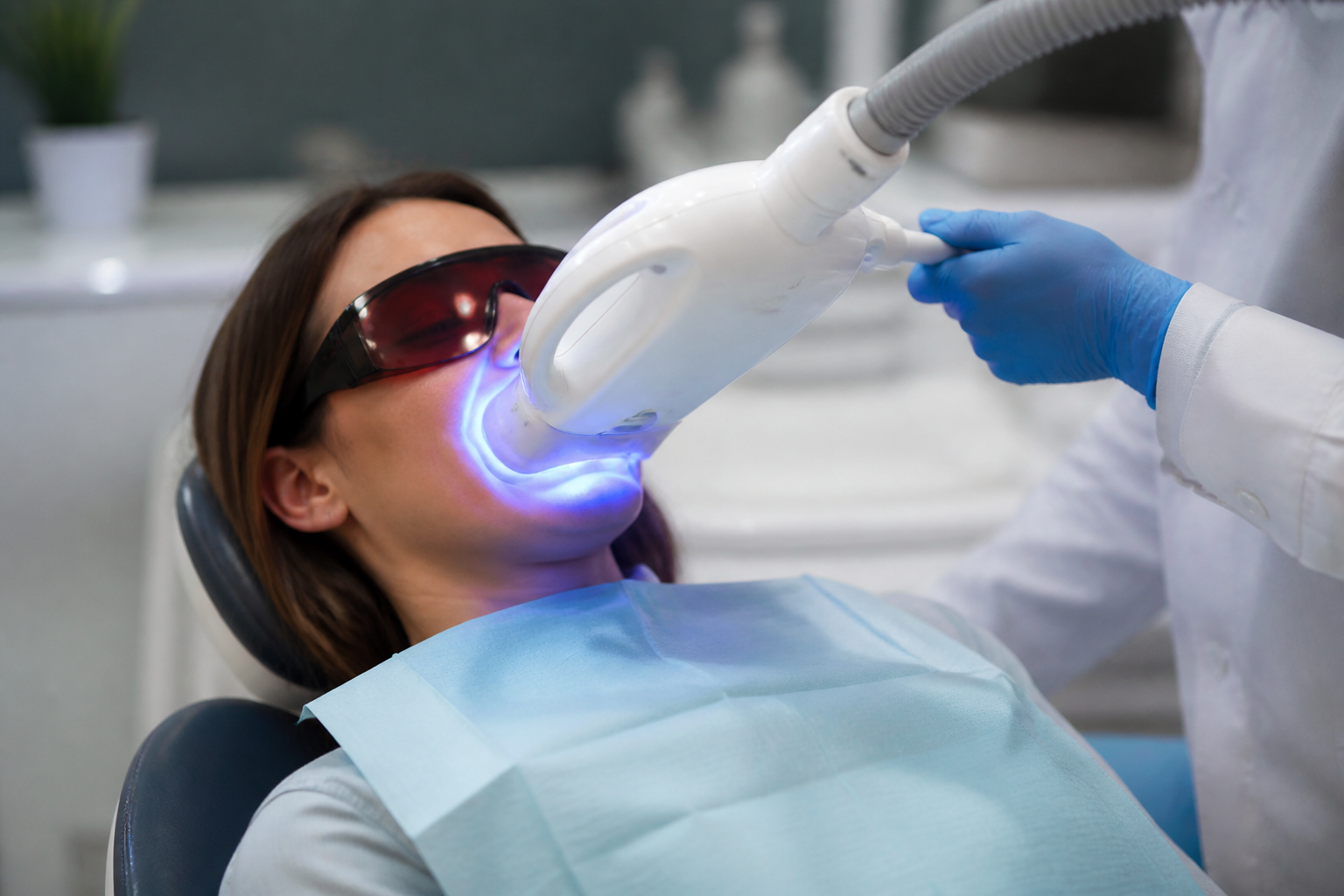
Teeth Whitening
What is teeth whitening (bleaching) treatment?
Teeth whitening (bleaching) is the procedure that removes discoloration that has penetrated deeply into the tooth structure due to genetic factors, ageing, certain medicines or external factors (tea, coffee, smoking, etc.). Simple stains on the tooth surface can be removed with scaling and brushing, whereas permanent, deep discoloration that has reached the inner layers of enamel can only be resolved using professional whitening agents. The main aim is to obtain a natural, bright smile without harming the patient’s tooth tissue.
Who is it suitable for?
- Those with genetically yellow or brown tones of discoloration in their teeth,
- People whose teeth have yellowed because of heavy tea, coffee or smoking habits,
- Those with mild yellow and grey discoloration linked to past antibiotic use (especially tetracycline),
- Those with teeth that have darkened after losing vitality (non-vital) following root canal treatment or trauma,
- Patients with fluorosis whose enamel tissue is not lost (worn away).
Who is it not applied to? Whitening is not applied to pregnant or breastfeeding women, people with advanced tooth sensitivity and excessive enamel loss (destroyed enamel), those with peroxide or latex allergy, or patients receiving chemotherapy/radiotherapy.
How does treatment proceed?
Whitening is applied by two main methods according to the patient’s need, time and sensitivity:
- In-office (clinic) whitening: The fastest and most effective method. The dentist first isolates the gums and soft tissues with a protective barrier gel. Whitening agent is then applied to the tooth surfaces and activated with blue light (laser) or chemically. The procedure is applied in 3 periods of 15 minutes each. Its greatest advantage is that the result is obtained immediately in as little as 30-45 minutes. It can be repeated for 1-2 sessions according to need.
- Home whitening: Custom clear trays are prepared from digital or standard impressions of the patient’s mouth. Special whitening gels given by the dentist are squeezed into these trays and the patient is asked to wear the trays for 3-4 hours a day. Treatment duration is determined by the dentist according to the intensity of discoloration, the shade lightening aimed for and the patient’s sensitivity.
- Bio Whitening technology: A system developed especially for patients with sensitive teeth. Thanks to this technology, extremely comfortable and safe whitening is provided without creating zinging in the enamel.
Points to consider before treatment
- Professional scaling and polishing must be carried out before treatment so that the whitening gels can fully contact the enamel.
- If there is decay, leaking old fillings or gum disease in the mouth, these problems must be treated before whitening.
- Existing tooth sensitivity or allergies must be reported to the dentist in advance.
Points to consider after treatment
- For the first few days after whitening (especially the first 48 hours) the teeth are very open to staining agents. During this period tea, coffee, smoking, red wine, tomato paste, sour-cherry juice and similar colouring foods and drinks must be avoided completely.
- Mild hot-cold sensitivity temporarily is normal; desensitising toothpastes your dentist may recommend can be used.
- How long the whiteness lasts depends entirely on the patient’s oral hygiene and diet. The colour obtained can be kept for many years with regular brushing.
Both methods are highly effective. In-office whitening offers a fast result in 45 minutes in the clinic, while home whitening proceeds under the patient’s own control over several weeks. The most lasting and ideal results are generally obtained in “combined” treatments in which in-office whitening is supported by home whitening.
Yes. “Bio Whitening technology”, developed especially for sensitive teeth, is used in our clinic. In this way you can have white teeth comfortably, without severe zinging during or after the procedure.
Teeth whitening carried out under specialist dental control, with the correct indication and with professional gels approved by the Ministry of Health/FDA, does not cause structural harm to the enamel.
After whitening, teeth never fully return to their darkest pre-treatment shade. However, heavy tea, coffee and smoking can cause the colour to recede somewhat over time. Brightness is maintained with routine brushing and check-ups every 6 months; if needed, short reminder sessions with home trays can be done every 1-2 years.